default


Story: Tradition: Roles in Society
Summary: This story brings to mind the opening scenes of "Fiddler on the Roof" where we're reintroduced to Tevye the dairyman and the character of the Fiddler. It establishes the central tension in the story between tradition and change. The video in this segment includes the traditional roles of men, women, and children in the fictional town of Anatevka. Use this story as a trigger to talk about traditional occupations and stereotypes in the small Russian village of Anatevka. What do we recall about our childhood memories of adulthood? What can we remember about the roles of men and women in our family stories? How have roles, especially gender roles, changed?
Page 1: Men's roles in society
Caption:
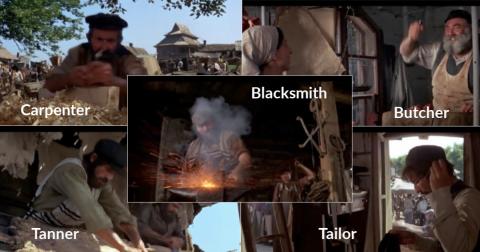
Traditional roles for men
Narration:
In Anatevka, tradition guided the villagers: how they slept, how they ate, how they dressed, and what they did. Men could become carpenters or butchers or blacksmiths, for example.
Description:
Media used by template player:
Minimum duration:
14000
Prompts:
Features:
Featured story idea

West Side Story was an acclaimed and popular Broadway musical about an ill-fated and impossible love between Tony and Maria. This story is about a recording of the Broadway score in 1984, 25 years later. Bernstein records the songs with a new generation of performing artists, renown singers who learned to act in the opera rather than Broadway actors who learned to sing in the theater. It's a remarkable documentary that captures the dynamic between the maestro and these superstars.
Perhaps because Bernstein is conducting his own piece as an old man, music that he composed many years earlier as a much younger man, you can talk about aging in this context. What does it mean to return to a work from your youth?